Hess King Newswire plan

16 offices. One release each. Clifton is not included.

The grid

One row per office. Open a row to read the full release.

Yes = OK to send later
No = do not send
Comment = a note for us
Your answers save on their own. Come back any time and they will still be here.

Wednesday's three are today's. Their send times may pass before you see this page. Nothing was sent. After a Yes, they go the same day if time allows, or the next morning.
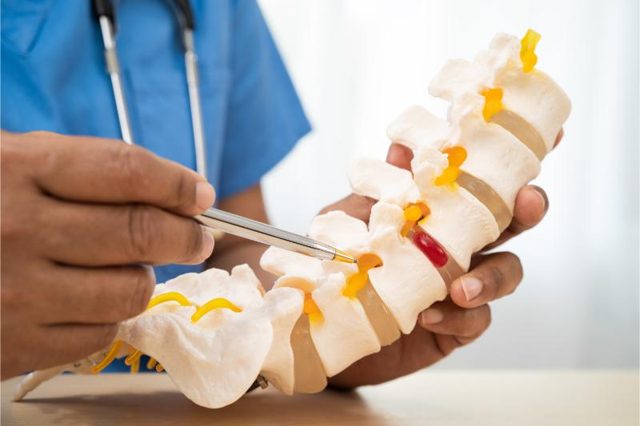
Wednesday, November 11 (today) · 3 releases
Union
North Jersey
Today's three
Hess Spine and Orthopedics - Union, 950 West Chestnut St, Suite 102, Union, NJ 07083, 908-300-5559
Picture planned for the Union releasePicture planned for the Union release

New Jersey Logged 66,800 Workplace Injuries in 2023: Union Spine Team Names Higher Risk Jobs

Why this one: Workers' comp is Union's biggest lane. This topic is new for the office.
Episode: Episode 213327 recorded. Not public yet.
Main keyword: workers comp back injury doctor Union NJ
Also aims at: injured at work NJ second opinionwork injury orthopedic Union County
Read the full release (775 words)
Summary: Hess Spine and Orthopedics in Union, NJ, cites 66,800 New Jersey workplace injuries and illnesses in 2023, names the jobs that carry the most back and neck strain, and explains how injured workers are evaluated at the Union office.
Meta keywords: Union NJ spine work injury doctor workers comp NJ
New Jersey private employers reported about 66,800 nonfatal workplace injuries and illnesses in 2023, according to the U.S. Bureau of Labor Statistics. Hess Spine and Orthopedics in Union, NJ, is using that figure to explain what back and neck problems from the job look like in Union County and nearby Essex County, and what happens when a worker finally gets them checked. The New Jersey Department of Labor and Workforce Development reports the same 2023 figure from the federal Survey of Occupational Injuries and Illnesses. Over a longer view, New Jersey Department of Health occupational health data covering 2000 through 2019 show that 48 percent of work-related musculoskeletal disorder cases involved the back and 27 percent involved the neck, shoulders, and upper extremities. Those shares explain why a spine and orthopedic office sees so many job-related visits. The jobs behind the numbers are familiar to anyone who lives in the corridor between Route 22 and the Garden State Parkway. Construction, health care, warehouse and factory work, commercial driving, public safety, hospitality, and retail all involve heavy lifting, patient handling, long hours at the wheel, or repetitive motion. Long stretches of sitting with poor posture add to the list. Most of these injuries do not begin with one dramatic moment. A tight lower back after a month of lifting, a neck that will not loosen after a season of overhead work, or tingling that follows a long shift can all point to a problem that deserves a closer look. At the Union office, evaluations cover back, neck, joint, hand, and sports injuries, with attention to conditions such as sciatica, herniated and bulging discs, spinal stenosis, and general neck and back symptoms. A first visit starts with the story of how the problem began, what the job demands each day, and what has changed since. A physical examination and a review of any imaging follow, and the specialist explains the findings in plain terms before recommending next steps. Most treatment plans begin with nonsurgical approaches such as activity guidance, therapy, and targeted injections. Minimally invasive techniques are considered only when the findings warrant them, and the benefits and risks depend on the procedure and the patient. The practice works with most insurance, including car accident and workers' compensation claims, and staff help patients confirm insurance details and which records to bring. Workers hurt on the job can read about workers' compensation care at the Union office at https://hessorthopedics.com/union-nj-workers-comp-orthopedic/. Benefits vary by case, so employees are encouraged to ask their employer, carrier, or attorney how the rules apply to them. Getting an early evaluation can clarify the extent of an injury and shape a recovery plan that fits the demands of a particular job, which is why workers with back or neck symptoms are encouraged to seek a timely assessment rather than wait for the problem to settle on its own. Documentation is a practical part of the picture. Workers are encouraged to keep notes on when symptoms began, which tasks make them worse, and who was told about the injury and when. Photographs of a hazard, names of coworkers who saw the incident, and copies of any incident report can all be useful to bring to a visit. The clinician uses that history to connect what the exam shows with what the job involves. Return to work is a common concern, and it is discussed openly at the Union office. Depending on the findings, a plan might include modified duty, limits on lifting or bending for a set period, or a gradual return to full duties as strength comes back. The specialist explains the reasoning for any restriction in plain terms so that a worker can discuss it with an employer. Follow-up visits check progress and adjust the plan if symptoms change. Clear answers also help coworkers, supervisors, and family members, who often notice a change in how someone lifts or moves before the worker says anything. For Union County workers, the practical message is short. A job-related ache that lasts more than a few days, grows worse with lifting, or travels into an arm or a leg is worth having examined. A clear diagnosis and a written plan make it easier to talk with an employer, to return to work with realistic expectations, and to avoid turning a manageable strain into a long-term limitation. The Hess Spine and Orthopedics office in Union is at 950 West Chestnut St, Suite 102, Union, NJ 07083. Call 908-300-5559, request an appointment at https://hessorthopedics.com/get-started/, or find the office on its Google Business Profile at https://www.google.com/maps?cid=2707936878520463928. More information about Hess Spine and Orthopedics and its Union location is available at https://hessorthopedics.com/location/orthopedic-surgeon-union-new-jersey/
Sewell
South Jersey
Today's three
Hess Spine and Orthopedics - Sewell, 483 Hurffville - Cross Keys Rd, Sewell, NJ 08080, 862-457-4014
Picture planned for the Sewell releasePicture planned for the Sewell release

Sewell Specialists Explain the 24 to 72 Hour Rule of Thumb for Getting Checked After a Crash

Why this one: Biggest organic office with no King release yet. A real question people ask after a crash.
Episode: Episode 213082 recorded. Not public yet.
Main keyword: car accident doctor Sewell NJ
Also aims at: how soon to see a doctor after a car accident NJNJ PIP choose your own doctor
Read the full release (613 words)
Summary: Hess Spine and Orthopedics in Sewell, NJ, explains the 24 to 72 hour rule of thumb for getting checked after a car crash and why symptoms can show up days later for Gloucester County drivers.
Meta keywords: Sewell NJ spine car accident doctor Gloucester County
A common rule of thumb after a car accident is to get checked within 24 to 72 hours, even when nothing hurts yet. Hess Spine and Orthopedics in Sewell, NJ, evaluates accident-related neck, back, and joint symptoms for Gloucester County drivers hurt in crashes along the Route 55 and Route 322 corridors, and the office is explaining why that window matters. The reasoning starts with how the body responds to trauma. Adrenaline and shock after a collision can mask pain, so a driver who steps out of the car feeling fine may not realize anything is wrong. Whiplash, concussions, back strain, and soft tissue injuries can take hours or even days to surface. As adrenaline falls, inflammation takes over, and stiffness, soreness, headaches, or limited movement may appear the next morning or the day after. The window matters for a second reason. A prompt evaluation helps identify hidden injuries early and records symptoms close to the date of the crash. That record gives a clinician a baseline to compare against if symptoms change. Questions about how timing affects an insurance claim belong with the insurer or an attorney, and the office does not give legal advice. Some warning signs call for emergency care right away instead of a scheduled visit. Numbness, weakness, severe headache, confusion, or loss of bladder or bowel control after a crash need an emergency department, not an appointment. For everything that is not an emergency, the Sewell office offers a structured first visit. Clinicians begin with the accident timeline, including the direction of impact, whether a seat belt was worn, and when each symptom first appeared. They then examine function and symptoms, review any imaging from an emergency room or urgent care, and explain what they find before recommending nonsurgical or surgical paths. Many plans begin with activity guidance, therapy, or injections, and minimally invasive options are considered when the findings call for them. Patients are encouraged to bring identification, insurance information, any discharge papers from an emergency visit, and photographs or notes about the crash. Staff can also help patients confirm which records to bring before the visit. The practice works with most insurance, including car accident and workers' compensation claims. Drivers in Sewell, Washington Township, Glassboro, Mullica Hill, and nearby Gloucester County communities often assume that a crash with no immediate pain needs no follow-up. The 24 to 72 hour rule of thumb exists to correct that assumption. A short visit early in the week after a crash can rule out a developing problem or start care before it becomes harder to treat. Children and older passengers deserve the same attention. Smaller bodies and older spines respond to impact differently, and a child may not describe symptoms clearly. A parent who notices that a child is unusually quiet, favors one side, or avoids a favorite activity after a crash can mention it at the first visit. Follow-up matters after the first visit. Symptoms that were quiet on day one can change by day five, so patients are encouraged to report new numbness, worsening headaches, or trouble sleeping to the office as they appear. Residents who were in a collision and are noticing neck stiffness, a sore back, headaches, or a joint that does not feel right are encouraged to schedule an evaluation. The Sewell office evaluates back, neck, joint, and accident-related injuries in one place. The Hess Spine and Orthopedics office in Sewell is at 483 Hurffville - Cross Keys Rd, Sewell, NJ 08080. Call 862-457-4014, request an appointment at https://hessorthopedics.com/get-started/, or find the office on its Google Business Profile at https://www.google.com/maps?cid=3406950570964181244. More information about Hess Spine and Orthopedics and its Sewell location is available at https://hessorthopedics.com/location/orthopedic-surgeon-sewell-new-jersey/
West Windsor
Central Jersey
Today's three
Hess Spine and Orthopedics - West Windsor, 186 Princeton Hightstown Rd Bldg 3B #104, West Windsor, NJ 08550, 609-598-9699
Picture planned for the West Windsor releasePicture planned for the West Windsor release

West Windsor Specialists Explain What a Full Spine Evaluation After a Car Accident Covers

Why this one: A near-breakout office. Outside pickups move rank fastest here.
Episode: Episode 213335 recorded. Not public yet.
Main keyword: orthopedic doctor after a car accident near Princeton Junction
Also aims at: same-week orthopedic evaluation West Windsor NJwhat to do in the first 72 hours after a car accident NJ
Read the full release (623 words)
Summary: Hess Spine and Orthopedics in West Windsor, NJ, explains what a full spine and orthopedic evaluation after a car accident covers, from the crash history to the exam and imaging review.
Meta keywords: West Windsor NJ car accident spine Princeton Junction
Hess Spine and Orthopedics in West Windsor, NJ, is explaining what a full spine and orthopedic evaluation after a car accident covers, so that Mercer County residents know what to expect before they book. The office serves West Windsor, Princeton Junction, Plainsboro, Hightstown, and nearby communities along the Route 571 and Route 1 corridors. Many people picture a post-crash visit as a quick look at one sore spot. A full evaluation is broader. Shock and adrenaline can hide the true extent of an injury for hours or days, and several orthopedic injuries common in collisions are not obvious at first. Whiplash, hairline fractures, herniated discs, and soft tissue sprains or strains often surface after the crash day, which is why a complete picture matters. The evaluation at the West Windsor office begins with history. A clinician asks how the crash happened, including the direction of impact, where the patient was seated, and what the first symptoms were. Prior injuries and existing conditions matter too, because they help separate what the crash changed from what was already there. A physical examination follows. The clinician checks posture, range of motion in the neck and back, strength, reflexes, and sensation in the arms and legs, and looks at the shoulders, hips, and knees when the patient reports symptoms there. This step shows where the body is guarding, where movement is limited, and where nerves may be involved. Imaging review comes next when the findings call for it. X-rays are useful for fractures and alignment, while an MRI is generally the better tool for soft tissue such as discs, ligaments, and nerve roots. The practice reviews imaging the patient already has from an emergency room or urgent care, and recommends additional imaging only when the exam suggests it would change the plan. After the review, the specialist explains the findings in plain terms and outlines next steps. For many patients that means a plan built around activity guidance, therapy, or targeted injections. Surgical consultation is discussed only when the findings point that way, and minimally invasive options are considered for selected patients. Patients are encouraged to bring identification, insurance information, discharge papers from any emergency visit, and any imaging discs or reports. Same-week visits are often possible, and staff can help patients confirm which records to bring. The practice works with most insurance, including car accident and workers' compensation claims. Commuters on the Northeast Corridor and the roads around Princeton Junction spend a lot of time in cars, and many collisions happen at low speed in traffic or parking areas. Low speed does not mean low risk. The same sudden stop that spills a coffee can strain a neck or back, and a seat belt that does its job can leave a bruised shoulder or chest wall. A full evaluation looks at those areas too. Patients who have already been seen in an emergency room are welcome to bring those records. A full evaluation builds on earlier care instead of repeating it, and the specialist can explain what the earlier tests did and did not show. Emergency warning signs are the exception. Numbness, weakness, severe headache, confusion, or loss of bladder or bowel control after a crash need emergency care right away. For everything else, an early and complete evaluation gives patients answers and a plan, and it creates a clear record of symptoms close to the date of the crash. The Hess Spine and Orthopedics office in West Windsor is at 186 Princeton Hightstown Rd Bldg 3B #104, West Windsor, NJ 08550. Call 609-598-9699, request an appointment at https://hessorthopedics.com/get-started/, or find the office on its Google Business Profile at https://www.google.com/maps?cid=989649122412312397. More information about Hess Spine and Orthopedics and its West Windsor location is available at https://hessorthopedics.com/location/orthopedic-surgeon-west-windsor-new-jersey/
Thursday, November 12 · 3 releases
Hackensack (Kotte Pl)
North Jersey
Hess Spine and Orthopedics - Hackensack, 19 Kotte Pl, Hackensack, NJ 07601, 201-633-8500
Picture planned for the Hackensack (Kotte Pl) releasePicture planned for the Hackensack (Kotte Pl) release

What Is Dashboard Knee: Hackensack Specialists Explain Knee Injuries That Appear Days After a Crash

Why this one: A named injury people search for. Not used before.
Episode: Episode 213067 recorded. Not public yet.
Main keyword: car accident knee injury doctor Hackensack NJ
Also aims at: dashboard kneeknee injury days after car accident
Read the full release (607 words)
Summary: Hess Spine and Orthopedics in Hackensack, NJ, explains dashboard knee, an injury pattern that can show up days after a crash, and how the office evaluates knee symptoms for Bergen County drivers.
Meta keywords: Hackensack NJ knee dashboard knee car accident injury
Hess Spine and Orthopedics in Hackensack, NJ, is explaining dashboard knee, a knee injury pattern that can appear hours or days after a car accident, for Bergen County drivers and passengers who travel Route 4, Route 17, and Route 80. Dashboard knee describes an injury in which an occupant's knee strikes the dashboard during a frontal collision. The force often strains or tears the posterior cruciate ligament, known as the PCL, and it can also fracture the kneecap. Adrenaline released during a crash can mask swelling, stiffness, or instability, which is a common reason symptoms seem to arrive late. A passenger can walk away from a minor collision and notice a sore, puffy knee the next day. The injury is not limited to the PCL. Dashboard knee can also involve patellar fractures, meniscus tears, cartilage damage, bone bruising, and sprains to the ACL, MCL, or LCL. These injuries overlap in how they feel, and the severity cannot be judged from the outside. Self-diagnosis after a crash is unreliable, so a professional evaluation is an important early step. At the Hackensack office, clinicians evaluate how the joint moves, how stable it is, and how it bears weight. They review available imaging as part of the process, since X-rays can miss ligament, meniscal, or cartilage damage and an MRI is often needed for a fuller picture. The goal of the first visit is a clear answer about what is injured and what the next step should be. Treatment depends on severity. Mild sprains may respond to rest, ice, compression, and elevation along with bracing and physical therapy. More serious tears can call for a surgical consultation. For patients whose imaging and exam findings point to structural damage, the practice offers injections, therapy planning, and procedures such as ligament reconstruction and cartilage repair, and it offers minimally invasive options when a case allows for them. Warning signs that call for prompt attention include a knee that gives way, a feeling of looseness, swelling that keeps returning, an inability to bear weight, or a joint that locks or catches. Pain, numbness, or color changes in the lower leg after a crash need emergency care right away. Patients are encouraged to bring identification, insurance information, and any emergency room paperwork or imaging from the crash. The practice works with most insurance, including car accident and workers' compensation claims. Passengers sit differently from drivers, and that changes the pattern of injury. A passenger with a leg propped near the dashboard, a driver braced against the wheel, and a rear-seat passenger thrown against the seat in front can all hurt a knee in different ways. The clinician asks about seating position and the moment of impact because those details help narrow down which structures took the load. A knee that feels better after a few days of rest is not always a knee that has healed. Instability can hide until the joint is asked to twist or bear weight again, so an exam that tests stability directly is more reliable than waiting to see. Bergen County residents with knee swelling, stiffness, or instability that developed after a collision are encouraged to seek an evaluation promptly rather than wait for symptoms to settle on their own. Early assessment can show whether a PCL injury, a cartilage problem, or another form of knee damage needs targeted treatment. The Hess Spine and Orthopedics office in Hackensack is at 19 Kotte Pl, Hackensack, NJ 07601. Call 201-633-8500, request an appointment at https://hessorthopedics.com/get-started/, or find the office on its Google Business Profile at https://www.google.com/maps?cid=12748841819914383588. More information about Hess Spine and Orthopedics and its Hackensack location is available at https://hessorthopedics.com/location/orthopedic-surgeon-hackensack-new-jersey/
Woodbridge
Central Jersey
Hess Spine and Orthopedics - Woodbridge, 843 Rahway Ave, Woodbridge, NJ 07095, 609-596-2298
Picture planned for the Woodbridge releasePicture planned for the Woodbridge release

Stiff Neck That Will Not Settle: Woodbridge Spine Specialists Explain When to Get It Checked

Why this one: Rank slipped here. Neck is a new topic. Goes out before the Nov 17 holiday posts.
Episode: Not recorded yet. Topic comes from the office plan.
Main keyword: neck pain specialist Woodbridge NJ
Also aims at: spine specialist Woodbridge NJwhen to see a spine specialist for neck pain
Read the full release (609 words)
Summary: Hess Spine and Orthopedics in Woodbridge, NJ, explains when a stiff neck that will not settle deserves a spine evaluation and what that visit involves for Middlesex County patients.
Meta keywords: Woodbridge NJ spine neck specialist NJ spine specialist
Hess Spine and Orthopedics in Woodbridge, NJ, is explaining when a stiff neck that will not settle deserves an evaluation by a spine specialist. The office serves Woodbridge, Iselin, Edison, Rahway, Carteret, and nearby Middlesex County communities. Most stiff necks pass. A night on a bad pillow, a long day at a desk, or a hard workout can leave the neck tight for a few days, and rest, gentle movement, and heat or ice are common first steps. The question the office is addressing is the other group, the neck that does not follow that script. When stiffness lasts beyond a couple of weeks, keeps returning, or comes with other symptoms, a closer look is reasonable. Several signs point toward a visit sooner. Tingling, numbness, or weakness in an arm or hand can mean a nerve in the neck is irritated. Headaches that start at the base of the skull, a neck that is worse in the morning, or pain that wakes a person at night also deserve attention. So does stiffness that follows a fall, a sports collision, or a car accident, since neck injuries can take days to show themselves. A small number of symptoms need emergency care instead of an appointment. A sudden severe headache with a stiff neck and fever, loss of bladder or bowel control, trouble walking, or sudden weakness in both arms or legs should be treated as an emergency. A first visit at the Woodbridge office starts with a conversation. The clinician asks when the stiffness began, what makes it better or worse, how work and sleep habits fit in, and whether anything has traveled into the shoulder or arm. A physical examination follows, with attention to how far the neck turns and bends, muscle strength, reflexes, and sensation. Imaging is reviewed when the findings call for it, and patients are encouraged to bring any X-rays or MRI reports they already have. Neck problems have many causes, including muscle strain, arthritis of the small joints, a bulging or herniated disc, and narrowing around a nerve. Naming the cause matters because it shapes treatment. Many plans begin without surgery, using activity guidance, posture and workstation changes, therapy, or targeted injections. Surgical consultation is discussed only when the findings point that way, and minimally invasive techniques are considered for selected patients. The practice works with most insurance, including car accident and workers' compensation claims, and staff help patients confirm insurance details and which records to bring. Everyday habits play a role as well. Long hours looking down at a phone or laptop, a monitor set too low, sleeping on a stack of pillows, and carrying a heavy bag on one shoulder can all keep a neck irritated. The clinician talks through these habits at the visit and suggests practical changes alongside any treatment, because a plan that ignores the daily routine often does not last. Keeping a short symptom diary for a week before the visit can help. Notes on time of day, activity, and what eased the stiffness give the clinician a clearer picture than memory alone. Middlesex County residents who have been living with a stiff neck for weeks, or who notice tingling or weakness along with it, are encouraged to schedule an evaluation. A clear answer early on can save weeks of guesswork and help patients choose the next step with confidence. The Hess Spine and Orthopedics office in Woodbridge is at 843 Rahway Ave, Woodbridge, NJ 07095. Call 609-596-2298, request an appointment at https://hessorthopedics.com/get-started/, or find the office on its Google Business Profile at https://www.google.com/maps?cid=15244509330397994726. More information about Hess Spine and Orthopedics and its Woodbridge location is available at https://hessorthopedics.com/location/orthopedic-surgeon-woodbridge-new-jersey/
Galloway
South Jersey
Hess Spine and Orthopedics - Galloway, 506 S New York Rd Ste A, Galloway, NJ 08205, 609-666-0522
Picture planned for the Galloway releasePicture planned for the Galloway release

Casino and Hospitality Workers Hurt on the Job: Galloway Orthopedic Team Explains Next Steps

Why this one: Atlantic City hospitality workers. A local work-injury group with its own story.
Episode: Not recorded yet. Topic comes from the office plan.
Main keyword: workers comp orthopedic doctor Galloway NJ
Also aims at: casino worker injury doctor Atlantic Cityhospitality worker back injury NJ
Read the full release (634 words)
Summary: Hess Spine and Orthopedics in Galloway, NJ, explains next steps for casino and hospitality workers with back, knee, or shoulder injuries from the job and how the Galloway office evaluates them.
Meta keywords: Galloway NJ ortho casino worker injury workers comp doctor
Hess Spine and Orthopedics in Galloway, NJ, is explaining next steps for casino and hospitality workers who are hurt on the job. The office serves Galloway, Absecon, Egg Harbor Township, Pomona, Atlantic City, and nearby Atlantic County communities, where hospitality is a major source of work. Hospitality jobs ask a lot of the body. Housekeepers push heavy carts and lift mattresses, servers and bartenders carry trays and stand for long shifts, kitchen crews work on hard floors, and maintenance and facilities teams climb, kneel, and reach. Casino floors add long hours of standing, and dealers repeat the same motions for hours. Over time, those demands can strain the lower back, knees, shoulders, and wrists, and a single bad lift or a slip on a wet floor can cause an injury in an instant. The first step after a job-related injury is simple. Report it to a supervisor promptly and follow the employer's process. Then get evaluated. Workers sometimes wait because the pain seems manageable, because a shift is hard to miss, or because they are unsure how workers' compensation works. A delay can make it harder to connect symptoms to the event and harder to start care. A first visit at the Galloway office begins with how the injury happened and what the job requires each day. A clinician examines the affected area, checks strength, movement, and nerve function, and reviews any imaging from an urgent care or emergency visit. The specialist then explains the findings in plain terms and outlines next steps, including whether imaging, therapy, injections, or other care makes sense. Many plans start without surgery. Activity guidance, therapy, bracing, and targeted injections are common early steps. Surgical consultation is discussed only when the findings point that way, and minimally invasive options are considered for selected patients. Return-to-work questions, such as whether a worker can lift, stand, or climb for a full shift, are part of the conversation. Workers hurt on the job can learn about workers' compensation care on the Galloway office page of the Hess website. Benefits vary by case, and workers are encouraged to ask their employer, carrier, or attorney how the rules apply to them. The practice works with most insurance, including car accident and workers' compensation claims. Warning signs that need emergency care include numbness or weakness that is spreading, loss of bladder or bowel control, severe pain after a fall, or a joint that cannot bear weight. Seasonal work adds its own pattern. Summer crowds and busy event weekends mean longer shifts and faster pace, and workers who pushed through soreness in July may find it hard to ignore by fall. Staff at the Galloway office understand that schedules in this industry are irregular, and patients are encouraged to call ahead to find a visit time that fits a shift pattern and to ask which records to bring. A note on reporting is worth repeating. Some workers worry that reporting an injury will cost them hours or draw attention. The practical reality is that an unreported injury is harder to treat and harder to document. A short report and an early evaluation protect the worker's health first, and they make later conversations with an employer or carrier simpler. Hospitality workers in Atlantic County who are dealing with a sore back, a knee that gives out, or a shoulder that will not lift after an on-the-job injury are encouraged to schedule an evaluation. An early, clear diagnosis makes the path forward easier to follow. The Hess Spine and Orthopedics office in Galloway is at 506 S New York Rd Ste A, Galloway, NJ 08205. Call 609-666-0522, request an appointment at https://hessorthopedics.com/get-started/, or find the office on its Google Business Profile at https://www.google.com/maps?cid=6065617353554261111. More information about Hess Spine and Orthopedics and its Galloway location is available at https://hessorthopedics.com/location/orthopedic-surgeon-galloway-new-jersey/
Monday, November 16 · 3 releases
Fairfield
North Jersey
Hess Spine and Orthopedics - Fairfield, 310 Passaic Ave, Building B, Suite 302, Fairfield, NJ 07004, 973-718-7898
Picture planned for the Fairfield releasePicture planned for the Fairfield release

Second Opinion Before Spine Surgery: Fairfield Specialists Outline Nonsurgical Options to Try First

Why this one: Defends a keyword that slipped. A second opinion is a real decision moment.
Episode: Episode 213211 recorded. Not public yet.
Main keyword: non-surgical treatments for back pain Fairfield NJ
Also aims at: second opinion spine surgery NJdo I need surgery for a herniated disc
Read the full release (609 words)
Summary: Hess Spine and Orthopedics in Fairfield, NJ, explains why a second opinion before spine surgery is a sound step and which nonsurgical options are often tried first.
Meta keywords: Fairfield NJ spine second opinion NJ nonsurgical back NJ
Hess Spine and Orthopedics in Fairfield, NJ, is explaining why a second opinion before spine surgery is a sound step and which nonsurgical options are often tried first. The office serves Fairfield, West Caldwell, Cedar Grove, Wayne, Verona, and nearby Essex and Passaic County communities. Being told that surgery may be needed is a heavy moment. Patients often leave the appointment with more questions than answers and a decision that feels urgent. Getting another perspective is not a delay tactic. It is a recognized step in responsible decision-making that helps confirm a diagnosis, clarify treatment choices, and improve understanding of risks and expected outcomes before committing to a procedure. A second opinion carries particular weight in certain situations. Multi-level surgery or a spinal fusion recommendation is one. A complex condition is another. So is a plan that involves a procedure the original surgeon does not regularly perform. Lingering uncertainty about the diagnosis or the plan is itself a reasonable reason to ask for more input. A second opinion can go several ways. It may confirm the original recommendation. It may lead to a different diagnosis or a different plan. It may show that a period of nonsurgical care is reasonable before any operation is scheduled. All three outcomes are useful, because each gives the patient a clearer basis for the decision. At the Fairfield office, a second-opinion visit is a fact-finding conversation, not an automatic path toward an operation. The team reviews the patient's history, conducts an examination, and reads any imaging the patient brings. Patients are encouraged to bring MRI and X-ray reports along with the images themselves, notes from earlier visits, and a list of treatments already tried. The specialist then explains the findings in plain terms and discusses both nonsurgical and surgical options before outlining next steps. Many treatment plans begin without surgery. Activity guidance, physical therapy, anti-inflammatory medication, and targeted injections are common first steps, and the right mix depends on the diagnosis. When surgery is appropriate, minimally invasive techniques may be considered for selected patients, and the benefits and risks depend on the procedure and the findings. Workers hurt on the job who have been told they need spine surgery can also ask for a second opinion, and the practice works with most insurance, including car accident and workers' compensation claims. Questions about coverage rules belong with the insurer, the employer, or an attorney. Preparing for a second-opinion visit helps the time go further. Patients can write down the diagnosis they were given, the procedure that was recommended, and the questions that remain, such as what happens if surgery is delayed, what nonsurgical care has already been tried, and what recovery would look like. Bringing a family member to the visit is often helpful, since a second set of ears catches details that are easy to miss. Time pressure is another reason to ask. Unless symptoms are severe or worsening quickly, there is usually room to gather information before a surgery date is set, and a clinician can explain which situations are more urgent than others. Patients should expect honest answers, including when the original plan still looks sound. Patients in Fairfield and the surrounding communities who have been recommended spine surgery are encouraged to schedule a second-opinion visit to review their case and their options before deciding how to proceed. The Hess Spine and Orthopedics office in Fairfield is at 310 Passaic Ave, Building B, Suite 302, Fairfield, NJ 07004. Call 973-718-7898, request an appointment at https://hessorthopedics.com/get-started/, or find the office on its Google Business Profile at https://www.google.com/maps?cid=6770016476440873215. More information about Hess Spine and Orthopedics and its Fairfield location is available at https://hessorthopedics.com/location/orthopedic-surgeon-fairfield-new-jersey/
Raritan
Central Jersey
Hess Spine and Orthopedics - Raritan, 1130 US-202 S, Suite 7, Raritan, NJ 08869, 908-633-4133
Picture planned for the Raritan releasePicture planned for the Raritan release

Sciatica Symptoms: Raritan Spine Specialists Explain Which Doctor to See and Options Before Surgery

Why this one: Sciatica and which doctor to see. Aims at a keyword that is close to winning.
Episode: Episode 213212 recorded. Not public yet.
Main keyword: non-surgical orthopedic solutions Raritan
Also aims at: sciatica specialist Raritan NJherniated disc surgery vs non-surgical Somerset County
Read the full release (601 words)
Summary: Hess Spine and Orthopedics in Raritan, NJ, explains sciatica symptoms, which kind of doctor to see, and the options that are usually tried before surgery.
Meta keywords: Raritan NJ spine sciatica specialist spine care Raritan
Hess Spine and Orthopedics in Raritan, NJ, is answering a question many Somerset County residents ask when pain starts running down a leg: which kind of doctor treats sciatica. The office serves Raritan, Somerville, Bridgewater, Branchburg, Flemington, and nearby communities along the US-202 corridor. Sciatica describes symptoms that follow the sciatic nerve as it travels from the lower back through the hips and buttocks and down each leg. People describe sharp or burning pain, tingling, numbness, or weakness in one leg, often worse when sitting, coughing, or bending. Because several different problems can irritate the nerve, patients are often unsure whether an orthopedic specialist, a neurosurgeon, or a pain management doctor is the right first stop. Common causes include a herniated disc pressing on a nerve root, narrowing of the spinal canal known as stenosis, and joint or muscle problems that irritate the nerve. Orthopedic spine specialists typically evaluate sciatica that comes from the spine and skeleton, while neurosurgeons focus on nerve problems that may need surgical repair. At the Raritan office, orthopedic and spine specialists work together to help patients find the right path, so a first visit does not require guessing in advance. A first visit starts with symptoms and history. The clinician asks where the symptoms travel, what makes them better or worse, and how long they have lasted. A physical examination checks strength, reflexes, sensation, and movement. Any X-rays or MRI reports the patient already has are reviewed, and new imaging is recommended only when the findings suggest it would change the plan. Many cases of sciatica improve with conservative care. Plans often begin with activity guidance, physical therapy, medication management, and sometimes a targeted injection near the irritated nerve. Surgery is considered when symptoms persist despite that care, when weakness is getting worse, or when imaging shows a clear structural cause. Procedures such as microdiscectomy and laminectomy relieve pressure on the nerve by addressing a herniated disc or narrowing in the spinal canal, and minimally invasive techniques are used when a patient's case allows. Some symptoms call for emergency care instead of an appointment. Loss of bladder or bowel control, numbness in the groin or inner thighs, or sudden weakness in a leg should be treated as an emergency. The practice works with most insurance, including car accident and workers' compensation claims, and staff help patients confirm insurance details and which records to bring. Posture and daily habits can influence sciatica symptoms, and the clinician reviews them. Long drives on US-202 or Interstate 287, hours at a desk, and lifting without bending the knees can all aggravate the lower back. Simple changes such as standing breaks, a supportive chair, and a lifting technique that uses the legs often become part of the plan, alongside therapy and any other treatment. Patients are encouraged to track which positions ease the symptoms. Relief when walking, or when lying on one side, tells the clinician something about which structure is involved and helps shape the plan. Keeping a short list of medications and past back problems also helps the first visit go smoothly. Somerset County residents with leg pain, tingling, numbness, or weakness are encouraged to schedule an evaluation at the Raritan office. A clear diagnosis and a stepwise plan can help patients avoid months of trial and error. The Hess Spine and Orthopedics office in Raritan is at 1130 US-202 S, Suite 7, Raritan, NJ 08869. Call 908-633-4133, request an appointment at https://hessorthopedics.com/get-started/, or find the office on its Google Business Profile at https://www.google.com/maps?cid=1023898662763176950. More information about Hess Spine and Orthopedics and its Raritan location is available at https://hessorthopedics.com/location/orthopedic-surgeon-raritan-new-jersey/
Cherry Hill
South Jersey
Hess Spine and Orthopedics - Cherry Hill Township, 496 Kings Hwy N #210, Cherry Hill Township, NJ 08034, 862-343-5726
Picture planned for the Cherry Hill releasePicture planned for the Cherry Hill release

Knee That Locks, Catches or Gives Way: Cherry Hill Orthopedic Specialists Explain What It Can Mean

Why this one: Knee is Cherry Hill's open lane. Aims at a keyword that is close to winning.
Episode: Not recorded yet. Topic comes from the office plan.
Main keyword: knee doctor Cherry Hill NJ
Also aims at: arthroscopic knee surgeon Cherry Hill NJCherry Hill joint pain specialists
Read the full release (628 words)
Summary: Hess Spine and Orthopedics in Cherry Hill, NJ, explains what it can mean when a knee locks, catches, or gives way, and how the office evaluates mechanical knee symptoms.
Meta keywords: Cherry Hill NJ knee knee locking causes Cherry Hill ortho
Hess Spine and Orthopedics in Cherry Hill, NJ, is explaining what it can mean when a knee locks, catches, or gives way. The office serves Cherry Hill, Haddonfield, Voorhees, Marlton, Pennsauken, and nearby Camden County and South Jersey communities. These three symptoms describe different things, and the differences help point toward a cause. A knee that locks stops moving partway through bending or straightening, as if something is blocking the joint. A knee that catches snags briefly, often with a click, and then moves on. A knee that gives way suddenly feels unstable, as though it might buckle under body weight. Any of them can come and go, which is why people sometimes put off an evaluation. Locking and catching are often linked to a problem inside the joint. A torn piece of meniscus, the cushion between the thigh bone and shin bone, can slip into the wrong place. A loose fragment of cartilage can do the same. Giving way is more often tied to stability, such as a ligament injury or weakness in the muscles that support the joint, although a mechanical problem can cause it too. Swelling that returns after activity, a sense of looseness, and trouble going down stairs are other signs that deserve a look. None of this can be sorted out from symptoms alone, which is the point of an evaluation. At the Cherry Hill office, a clinician begins with when the knee first caught or gave way, what the person was doing, and what the knee does now. A physical examination checks swelling, range of motion, stability, and tenderness along the joint line. Imaging is reviewed when the findings call for it. X-rays show bone and alignment, while an MRI shows the meniscus, cartilage, and ligaments in more detail. Treatment depends on the cause. Plans often begin with activity guidance, therapy to strengthen the muscles around the knee, bracing, and sometimes a targeted injection. When a mechanical problem is clear and symptoms persist, arthroscopic surgery, a minimally invasive approach that uses small incisions and a camera, may be discussed. The benefits and risks depend on the procedure and the findings, and surgery is considered only when the exam and imaging point that way. A knee that cannot bear weight, looks visibly out of shape, or becomes hot, red, and swollen with fever needs urgent attention. So does a knee that is locked in place and cannot be moved at all. The practice works with most insurance, including car accident and workers' compensation claims. Patients are encouraged to bring identification, insurance information, and any earlier imaging. Age and activity both matter. Younger patients with sports injuries and older patients with wear in the joint can have similar symptoms for very different reasons, so the plan is matched to the person. A runner whose knee catches on stairs and a gardener whose knee gives out after kneeling may both be helped by an exam that looks at the whole leg, not only the knee. Hip and ankle problems can change how the knee behaves, and the clinician checks them too. A short video of the knee catching, or notes about the moment it gave way, can help at the visit, because the symptom does not always repeat in the exam room. Camden County residents whose knees lock, catch, or give way are encouraged to schedule an evaluation. A clear diagnosis can turn a worrying, unpredictable symptom into a plan. The Hess Spine and Orthopedics office in Cherry Hill is at 496 Kings Hwy N #210, Cherry Hill Township, NJ 08034. Call 862-343-5726, request an appointment at https://hessorthopedics.com/get-started/, or find the office on its Google Business Profile at https://www.google.com/maps?cid=10828812625212567982. More information about Hess Spine and Orthopedics and its Cherry Hill location is available at https://hessorthopedics.com/location/orthopedic-surgeon-cherry-hill-new-jersey/
Thursday, November 19 · 7 releases
Jersey City
North Jersey
Hess Spine and Orthopedics - Jersey City, 631 Grand St #2-100, Jersey City, NJ 07304, 201-255-5557
Picture planned for the Jersey City releasePicture planned for the Jersey City release

Work Injury Affecting Both Neck and Shoulder: Jersey City Orthopedic Team Explains the Connection

Why this one: A second work-injury angle, 15 miles from Union, on a different day with a different question.
Episode: Not recorded yet. Topic comes from the office plan.
Main keyword: workers comp orthopedic doctor Jersey City NJ
Also aims at: work injury neck and shoulder NJJersey City orthopedic specialists
Read the full release (691 words)
Summary: Hess Spine and Orthopedics in Jersey City, NJ, explains how a single work injury can affect both the neck and the shoulder and how the Jersey City office evaluates the connection.
Meta keywords: Jersey City NJ ortho work injury doctor neck shoulder injury
Hess Spine and Orthopedics in Jersey City, NJ, is explaining how a single work injury can affect both the neck and the shoulder, and why the two are often evaluated together. The office serves Jersey City, Hoboken, Bayonne, Union City, Secaucus, and nearby Hudson County communities. The neck and shoulder share muscles, joints, and nerves. Nerves that leave the spine in the neck travel through the shoulder and down the arm, and the muscles that hold the head up also anchor the shoulder blade. A strain, a jolt, or months of repetitive overhead work can therefore leave a worker with symptoms in both places. Someone who sees a doctor only about the shoulder may miss a neck problem that is feeding it, and the reverse is true as well. Hudson County workers will recognize the jobs where this happens. Delivery and warehouse crews lift and reach all day, construction and trades workers work overhead, building maintenance teams haul equipment up stairs, and office and transit workers spend long hours in fixed positions. A fall from a ladder, a heavy box that shifts, or a sudden pull on an arm can start the problem in an instant. More often, it builds slowly until a worker notices that raising an arm is hard and the neck feels tight at the same time. Clues that the neck may be involved include pain that starts at the base of the neck and spreads across the shoulder, tingling or numbness that reaches the hand, weakness in grip, and symptoms that change when the head turns or tilts. A shoulder problem on its own more often shows up as pain with specific arm movements, trouble sleeping on one side, or clicking in the joint. Because these can overlap, a careful exam is the most reliable way to tell them apart. At the Jersey City office, a first visit starts with how the injury happened and what the job demands. A clinician examines the neck, shoulder, and arm, checks strength, reflexes, and sensation, and reviews any imaging that has already been done. Additional imaging is recommended only when the findings suggest it would change the plan. The specialist then explains what is going on in plain terms, including whether the neck, the shoulder, or both are involved. Many plans begin without surgery. Activity guidance, therapy, workstation changes, and targeted injections are common early steps. Surgical consultation is discussed only when the findings point that way, and minimally invasive techniques are considered for selected patients. Workers hurt on the job can learn about workers' compensation care on the Jersey City office page of the Hess website. Benefits vary by case, and workers are encouraged to ask their employer, carrier, or attorney how the rules apply. The practice works with most insurance, including car accident and workers' compensation claims. Commuting is part of life for Hudson County workers, and it affects recovery. Crowded trains, long walks across stations, and carrying a bag on one shoulder can keep an irritated neck and shoulder from settling. The clinician asks about these routines and suggests practical adjustments, such as switching shoulders, adjusting a bag strap, and taking short movement breaks, alongside any formal treatment. Documentation helps here as well. Workers are encouraged to note when the symptoms began, which tasks make them worse, and who was told about the injury and when. Copies of any incident report are useful to bring to a visit. The clinician uses that history to connect what the exam shows with what the job involves, and the notes make later conversations with an employer or carrier simpler. Hudson County workers with neck and shoulder symptoms after an injury on the job are encouraged to schedule an evaluation rather than treat the two areas separately. A single clear diagnosis makes the next step easier to choose. The Hess Spine and Orthopedics office in Jersey City is at 631 Grand St #2-100, Jersey City, NJ 07304. Call 201-255-5557, request an appointment at https://hessorthopedics.com/get-started/, or find the office on its Google Business Profile at https://www.google.com/maps?cid=13976188127450489943. More information about Hess Spine and Orthopedics and its Jersey City location is available at https://hessorthopedics.com/location/orthopedic-surgeon-jersey-city-new-jersey/
Hackensack University Plaza
North Jersey
Hess Spine and Orthopedics - Hackensack University Plaza, 2 University Plaza Dr. Floor 5, Suite 500, Hackensack, NJ 07601, 551-393-1444
Picture planned for the Hackensack University Plaza releasePicture planned for the Hackensack University Plaza release

Arm Tingling or Weakness May Start in the Neck: Hackensack University Plaza Spine Team Explains

Why this one: Neck and arm angle. Keeps this office apart from the other Hackensack office.
Episode: Episode 213338 recorded. Not public yet.
Main keyword: minimally invasive spine surgery Hackensack NJ
Also aims at: neck related arm tingling specialist Hackensackspine specialists near Hackensack University Medical Center
Read the full release (636 words)
Summary: Hess Spine and Orthopedics at University Plaza in Hackensack, NJ, explains why arm tingling or weakness may start in the neck and how the office evaluates it.
Meta keywords: Univ Plaza spine arm tingling neck Hackensack spine
Hess Spine and Orthopedics at University Plaza in Hackensack, NJ, is explaining why arm tingling, numbness, or weakness may start in the neck instead of the arm. The University Plaza office serves Hackensack, Teaneck, Paramus, Englewood, Fort Lee, and nearby Bergen County communities. It is easy to assume that a tingling hand or a weak arm is a problem with the hand or the arm. Often the source sits higher. Nerves that supply the shoulder, arm, and hand leave the spinal cord through small openings in the neck. When one of those nerves is pinched or irritated, the symptoms show up along the path of the nerve, sometimes far from the neck itself. The condition is known as cervical radiculopathy. Several things can irritate those nerves. A herniated disc can bulge into the space a nerve needs. Bone spurs and arthritis can narrow the openings. An injury from a fall, a sports collision, or a car accident can set the process off, and so can years of wear. People with the condition often describe a shooting sensation, a burning feeling, a hand that feels asleep, or a grip that is not as strong as it used to be. Turning or tilting the head can make it better or worse, which is another clue that the neck is involved. Because the source is in the neck, a spine specialist is often well placed to find the cause. At the University Plaza office, a first visit starts with a conversation about when the symptoms began, where they travel, and what changes them. A clinician examines the neck and arm, tests strength, reflexes, and sensation, and reviews any imaging the patient brings. An MRI or other imaging is recommended when the findings suggest it would change the plan. Treatment starts with the least invasive choices that fit the findings. Many patients begin with activity guidance, physical therapy, home exercise, and medication management. Standard symptom relief methods such as anti-inflammatory medication and alternating ice and heat are often part of the plan. Targeted injections may be used when symptoms persist. When those steps are not enough, surgery on the cervical spine may be discussed for neck stiffness or arm symptoms tied to disc problems or nerve compression. The goals of those procedures are to relieve pressure on the nerve, stabilize the neck, and restore movement, and the benefits and risks depend on the procedure and the patient. Some symptoms need emergency care. Sudden weakness in an arm or leg, trouble walking, loss of bladder or bowel control, or a severe headache with a stiff neck should be treated as an emergency. The practice works with most insurance, including car accident and workers' compensation claims, and staff help patients confirm insurance details and which records to bring. Everyday habits can keep a pinched nerve irritated. Hours of looking down at a screen, sleeping with the head propped at a steep angle, and carrying a heavy bag on one shoulder all load the neck. The clinician talks through these habits at the visit and suggests practical changes, such as raising a monitor, adjusting pillows, and taking short movement breaks, because a plan that ignores the daily routine often does not last. Bergen County residents who notice tingling, numbness, or weakness in an arm or hand that does not go away are encouraged to schedule an evaluation at the University Plaza office. Looking at the neck first can save weeks of treating the wrong spot. The Hess Spine and Orthopedics office in Hackensack University Plaza is at 2 University Plaza Dr. Floor 5, Suite 500, Hackensack, NJ 07601. Call 551-393-1444, request an appointment at https://hessorthopedics.com/get-started/, or find the office on its Google Business Profile at https://www.google.com/maps?cid=15111263991042049555. More information about Hess Spine and Orthopedics and its Hackensack University Plaza location is available at https://hessorthopedics.com/location/hackensack-university-plaza/
Old Bridge
Central Jersey
Hess Spine and Orthopedics - Old Bridge, 2204 NJ-18, Old Bridge, NJ 08857, 609-596-2499
Picture planned for the Old Bridge releasePicture planned for the Old Bridge release

Is an MRI Needed Right After a Car Accident: Old Bridge Spine Specialists Explain Imaging Timing

Why this one: Imaging timing after a crash. A common question. Different from Raritan's topic.
Episode: Episode 213078 recorded. Not public yet.
Main keyword: do I need an MRI after a car accident Old Bridge NJ
Also aims at: whiplash treatment near Old Bridgecar accident spine doctor Middlesex County
Read the full release (628 words)
Summary: Hess Spine and Orthopedics in Old Bridge, NJ, explains when an MRI is needed after a car accident and how imaging timing works for Middlesex County drivers.
Meta keywords: Old Bridge NJ spine MRI after accident car accident doctor
Hess Spine and Orthopedics in Old Bridge, NJ, is explaining when an MRI is needed after a car accident and how imaging timing works, for Middlesex County drivers who travel Route 18 and the surrounding roads. The office serves Old Bridge, Sayreville, Matawan, East Brunswick, Marlboro, and nearby communities. Many people leave a crash with one question: do an MRI and X-rays need to happen right away. The honest answer depends on the symptoms. Imaging is a tool, not a ritual, and the right test at the right time is more useful than every test on the first day. Timing matters because of how the body responds to a collision. Adrenaline and shock can mask symptoms for hours, and pain, numbness, or weakness may surface later. The days after a crash deserve attention even when the first hours felt fine. A clinical evaluation is the first step, because the exam shows which test, if any, is likely to help. The type of imaging matters as much as the timing. X-rays are useful for fractures and for checking alignment. An MRI is generally preferred for soft tissue, including disc herniations, ligament tears, and nerve compression, all of which are common after auto collisions. A normal X-ray does not rule out a soft tissue injury, which is why some patients with a clear X-ray still need an MRI. Certain signs commonly prompt a physician to order an MRI. Pain, tingling, weakness, or limited movement that persists or worsens over time is one. Symptoms that travel into an arm or a leg are another. Neurological changes, particularly when X-ray results do not explain what the patient feels, are a third. On the other hand, mild soreness that is steadily improving often does not call for an MRI right away, and a stepwise approach is reasonable. At the Old Bridge office, a first visit begins with the crash itself, including the direction of impact and when symptoms started. A clinician examines the affected area, tests strength, reflexes, and sensation, and reviews any X-ray or MRI records already on file, including those from an emergency room. Once imaging is reviewed, clinicians walk patients through what the findings mean and what comes next. The practice offers both nonsurgical and surgical paths depending on the findings. Many plans begin with activity guidance, therapy, or targeted injections, and minimally invasive options are considered for selected patients. The practice works with most insurance, including car accident and workers' compensation claims. Warning signs that need emergency care include loss of bladder or bowel control, numbness or weakness that is spreading, a severe headache, or confusion after a crash. Patients sometimes ask whether skipping an MRI could put recovery at risk. A stepwise approach does not mean ignoring symptoms. It means starting with an exam, tracking how symptoms change over the first days and weeks, and adding imaging when the picture calls for it. If symptoms worsen, the plan changes, and the clinician explains the reasons for each step so that patients are never left guessing about why a test was or was not ordered. Patients who already had an emergency room X-ray are encouraged to bring the report, since a normal film shows that bones are intact but says little about discs and ligaments. Drivers in Old Bridge and the surrounding area who have pain, numbness, or weakness after a collision are encouraged to schedule an evaluation to decide whether imaging is warranted for their specific symptoms. The Hess Spine and Orthopedics office in Old Bridge is at 2204 NJ-18, Old Bridge, NJ 08857. Call 609-596-2499, request an appointment at https://hessorthopedics.com/get-started/, or find the office on its Google Business Profile at https://www.google.com/maps?cid=4811964962119841416. More information about Hess Spine and Orthopedics and its Old Bridge location is available at https://hessorthopedics.com/location/orthopedic-doctor-old-bridge-new-jersey/
Hamilton
Central Jersey
Hess Spine and Orthopedics - Hamilton, 1601 Whitehorse Mercerville Rd Ste A, Hamilton, NJ 08619, 609-955-3127
Picture planned for the Hamilton releasePicture planned for the Hamilton release

Legs Tire When Standing but Ease When Sitting: Hamilton Spine Specialists Explain Spinal Stenosis

Why this one: Spinal stenosis. Several Hamilton keywords sit just off page one.
Episode: Not recorded yet. Topic comes from the office plan.
Main keyword: spinal stenosis doctor Hamilton NJ
Also aims at: spine specialist near me Hamilton Townshipspine care in Hamilton Township
Read the full release (611 words)
Summary: Hess Spine and Orthopedics in Hamilton, NJ, explains how legs that tire when standing but ease when sitting can point to spinal stenosis and how the office evaluates it.
Meta keywords: Hamilton NJ spine spinal stenosis NJ Mercer County spine
Hess Spine and Orthopedics in Hamilton, NJ, is explaining a pattern that sends many Mercer County residents looking for answers: legs that tire or ache when standing or walking but ease when sitting down. The pattern can point to spinal stenosis, and the office is describing how it is evaluated. The office serves Hamilton Township, Trenton, Robbinsville, Bordentown, Princeton, and nearby communities. Spinal stenosis is a narrowing of the spaces inside the spine that hold the spinal cord and nerves. In the lower back, the narrowing can crowd the nerves that serve the legs. Standing and walking tend to arch the lower back and tighten those spaces, which can bring on aching, heaviness, tingling, or weakness in the legs. Sitting or leaning forward tends to open the spaces, which is why relief often comes quickly. Many patients describe leaning on a shopping cart in a store because it feels easier. The pattern is a clue, not a diagnosis. Other problems can cause leg symptoms, including circulation problems, hip trouble, and nerve irritation from a herniated disc. That is why an evaluation matters. A clinician asks how far a person can walk before symptoms start, what position helps, and whether the symptoms affect one leg or both. A physical examination checks strength, reflexes, sensation, and how the back moves. Imaging, usually an MRI, is reviewed when the findings suggest stenosis, since it shows how much room the nerves have. Stenosis often develops gradually, in part because the discs and joints of the spine change with years of use. It can also be present from birth in some people, and it is more common in adults who have worked physically demanding jobs. A narrowed canal does not always cause symptoms, and symptoms do not always match what imaging shows, so the plan is built around how a patient feels and functions as well as the scan. Treatment begins with nonsurgical care for most patients. Activity guidance, therapy focused on the core and hips, medication management, and epidural or other targeted injections are common first steps. Surgery is considered when symptoms continue despite that care, when walking is increasingly limited, or when weakness is progressing. Procedures that make more room for the nerves, such as laminectomy, can be done through minimally invasive techniques for selected patients, and the benefits and risks depend on the procedure and the findings. Some symptoms need emergency care. Loss of bladder or bowel control, numbness in the groin or inner thighs, or sudden weakness in a leg should be treated as an emergency. The practice works with most insurance, including car accident and workers' compensation claims, and staff help patients confirm insurance details and which records to bring. Daily life offers some practical clues. Patients with stenosis often find that cycling or using a stationary bike is easier than walking, because the forward-leaning posture opens the space around the nerves. Grocery shopping with a cart, walking uphill, and standing in line can feel very different from walking on flat ground. Sharing those details at the visit helps the clinician build a clearer picture than a scan alone can provide. Mercer County residents whose legs tire when standing but ease when sitting are encouraged to schedule an evaluation at the Hamilton office. A clear answer about the cause can keep a manageable condition from steadily shrinking daily activity. The Hess Spine and Orthopedics office in Hamilton is at 1601 Whitehorse Mercerville Rd Ste A, Hamilton, NJ 08619. Call 609-955-3127, request an appointment at https://hessorthopedics.com/get-started/, or find the office on its Google Business Profile at https://www.google.com/maps?cid=17343833767329622912. More information about Hess Spine and Orthopedics and its Hamilton location is available at https://hessorthopedics.com/location/orthopedic-surgeon-hamilton-new-jersey/
Lakewood
Central Jersey
Hess Spine and Orthopedics - Lakewood, 721 W Kennedy Blvd, Lakewood, NJ 08701, 732-633-6594
Picture planned for the Lakewood releasePicture planned for the Lakewood release

Minimally Invasive Spine Surgery Explained: Lakewood Specialists Outline Who Qualifies and Recovery

Why this one: Minimally invasive surgery is the one Lakewood keyword close to winning.
Episode: No episode. Topic comes from the office plan.
Main keyword: minimally invasive orthopedic surgery Lakewood
Also aims at: minimally invasive spine surgery Lakewood NJrecovery time minimally invasive spine surgery
Read the full release (628 words)
Summary: Hess Spine and Orthopedics in Lakewood, NJ, explains minimally invasive spine surgery, who may qualify, and what recovery generally involves for Ocean County patients.
Meta keywords: Lakewood NJ spine minimally invasive Lakewood spine care
Hess Spine and Orthopedics in Lakewood, NJ, is explaining minimally invasive spine surgery, who may qualify for it, and what recovery generally involves. The office serves Lakewood, Jackson, Toms River, Brick, Howell, and nearby Ocean County communities. Minimally invasive spine surgery is a way of reaching the spine through smaller openings than traditional open surgery. Instead of a long incision and wide muscle retraction, the surgeon uses small incisions and specialized tubes, instruments, and cameras to work on the problem. The aim is to treat the same condition while disturbing less healthy tissue along the way. The approach is a technique, not a single operation, and it is used for several different procedures. Not every patient or every condition is a match. Minimally invasive techniques are most often discussed for specific problems, such as a herniated disc pressing on a nerve, certain forms of spinal stenosis, and some cases of instability. A person is generally considered only after nonsurgical care has been tried, or when the findings and symptoms point clearly toward a procedure. Some conditions need a traditional approach to get the job done safely, and the decision is made case by case based on the exam, the imaging, and the patient's health and goals. Qualifying starts with an evaluation. At the Lakewood office, a clinician reviews the history, the symptoms, and what has already been tried. A physical examination checks strength, reflexes, sensation, and movement, and imaging is reviewed to see exactly what is pressing on the nerves. Patients are encouraged to bring MRI and X-ray reports along with the images. The specialist explains the findings in plain terms, outlines both nonsurgical and surgical choices, and answers questions about risks, benefits, and what each path would mean for work and home life. Many treatment plans begin without surgery at all. Activity guidance, physical therapy, medication management, and targeted injections are common first steps, and many patients improve with them. Surgery is considered when symptoms continue, when function is limited, or when imaging and the exam point to a clear structural cause. Recovery depends on the procedure, the condition, and the person. Because the openings are smaller, many patients have less discomfort around the incision and may leave the hospital or surgical center sooner than after open surgery, though this is not true for every case. Recovery generally includes a period of limited lifting and bending, a gradual return to walking and daily activity, and often a course of physical therapy. A clinician gives specific guidance on timing for work and driving, and follow-up visits track healing. Risks exist with any surgery, including infection, bleeding, and the possibility that symptoms do not fully resolve, and the surgeon reviews them before a decision is made. The practice works with most insurance, including car accident and workers' compensation claims. Questions are part of the process, and patients are encouraged to bring a written list. Useful topics include how many levels of the spine are involved, what the goals of the procedure are, what would happen without surgery, how long a hospital or surgical center stay is expected to last, and when a return to work or driving is realistic. A family member at the visit often helps, since the details are easy to forget. Ocean County residents who have been told they may need spine surgery, or who want to understand whether a minimally invasive approach fits their condition, are encouraged to schedule an evaluation at the Lakewood office. The Hess Spine and Orthopedics office in Lakewood is at 721 W Kennedy Blvd, Lakewood, NJ 08701. Call 732-633-6594, request an appointment at https://hessorthopedics.com/get-started/, or find the office on its Google Business Profile at https://www.google.com/maps?cid=12033022585009884615. More information about Hess Spine and Orthopedics and its Lakewood location is available at https://hessorthopedics.com/location/orthopedic-surgeon-lakewood-new-jersey/
Eatontown
Central Jersey
Hess Spine and Orthopedics - Eatontown, 285 Parker Rd, Eatontown, NJ 07724, 732-633-6588
Picture planned for the Eatontown releasePicture planned for the Eatontown release

Why Whiplash Symptoms Often Appear Days After a Crash: Eatontown Spine Specialists Explain

Why this one: Whiplash timing. A different angle from West Windsor's full evaluation.
Episode: Episode 213331 recorded. Not public yet.
Main keyword: car accident injury doctor Eatontown NJ
Also aims at: whiplash symptoms days after a crashGarden State Parkway crash back neck care Monmouth County
Read the full release (605 words)
Summary: Hess Spine and Orthopedics in Eatontown, NJ, explains why whiplash symptoms often appear days after a crash and how the Eatontown office evaluates delayed neck injuries.
Meta keywords: Eatontown NJ spine whiplash doctor NJ Monmouth County
Hess Spine and Orthopedics in Eatontown, NJ, is explaining why whiplash symptoms often appear days after a crash. The office serves Eatontown, Long Branch, Oceanport, Tinton Falls, Red Bank, and nearby Monmouth County communities, including drivers who travel the Garden State Parkway. Whiplash happens when the head moves suddenly forward and back, or side to side, stretching the muscles, ligaments, and other soft tissue of the neck. It is common in rear-end collisions but can follow any sudden stop, a sports collision, or a fall. A driver can feel fine at the scene and still have meaningful tissue strain. The delay traces back to the body's fight-or-flight response. Right after a sudden event, the body releases adrenaline and other chemicals that dull pain and sharpen alertness. That can hide damage to muscles, ligaments, and nerves for the first minutes and hours. As those chemicals settle, the body's inflammatory response takes over, and stiffness, soreness, and restricted movement often become noticeable in the one to three days that follow. That is why someone who dismisses a crash as minor may be surprised by a sore neck two mornings later. Common delayed symptoms include neck pain and stiffness, headaches that begin at the base of the skull, and trouble turning the head. Later in the first week, other signs may appear, including dizziness, fatigue, difficulty concentrating, tingling or numbness in the arms, and changes in mood or sleep. Not every symptom comes from the neck, but a pattern that starts after a crash is worth having examined. Seeking an evaluation promptly, even before pain develops, gives a clinician a baseline and a clear next step. At the Eatontown office, an evaluation starts with how the injury happened and what has changed since. A physical examination follows, checking neck movement, strength, reflexes, and sensation in the arms, and any available imaging is reviewed. Patients bring identification, insurance information, and any existing X-ray or MRI records or emergency visit paperwork to the first visit. A specialist can then outline a plan, which for many patients involves activity guidance, physical therapy, or targeted injections. Surgical consultation is discussed only when the findings point that way, and minimally invasive options are considered for selected patients. The practice works with most insurance, including car accident and workers' compensation claims. Emergency warning signs should not wait. Severe headache, confusion, weakness or numbness that is spreading, trouble walking, or loss of bladder or bowel control after a crash need emergency care right away. Sports and everyday activity can cause whiplash-type injuries too. A hard tackle, a fall from a bicycle, or a sudden jolt on a roller coaster can all stretch the neck in the same way a collision does. The evaluation approach is the same, and the clinician asks about the event, the timing of each symptom, and any earlier neck problems, since prior injuries can change both the symptoms and the plan. Keeping a simple record of symptoms over the first week gives the clinician useful detail, including when headaches began and which movements bring on stiffness. Monmouth County residents who have been in a collision, even one that seemed minor, are encouraged to schedule an evaluation with the Eatontown office rather than wait for symptoms to develop. Imaging review at the first visit can give patients clear answers about what comes next. The Hess Spine and Orthopedics office in Eatontown is at 285 Parker Rd, Eatontown, NJ 07724. Call 732-633-6588, request an appointment at https://hessorthopedics.com/get-started/, or find the office on its Google Business Profile at https://www.google.com/maps?cid=7729560478701938372. More information about Hess Spine and Orthopedics and its Eatontown location is available at https://hessorthopedics.com/location/orthopedic-surgeon-eatontown-new-jersey/
Little Falls
North Jersey
Waits: needs live page and Google profile
Hess Spine and Orthopedics - Little Falls, 201 Lower Notch Road, Little Falls, NJ 07424, 201-255-5556
Picture planned for the Little Falls releasePicture planned for the Little Falls release

Hess Spine and Orthopedics Opens Temporary Little Falls Office Serving Passaic County Patients

Why this one: Opening news for the temporary office. Waits for its page and Google profile.
Episode: Topic from episode 213083, which was on hold.
Main keyword: orthopedic doctor Little Falls NJ
Also aims at: workers comp orthopedic Passaic Countyhurt at work NJ what to do first
Read the full release (519 words)
Summary: Hess Spine and Orthopedics announces a temporary Little Falls, NJ, office serving Passaic County patients with spine and orthopedic evaluations, including for workers hurt on the job.
Meta keywords: Little Falls ortho Passaic County spine workers comp doctor
Hess Spine and Orthopedics has opened a temporary office in Little Falls, NJ, to serve patients in Passaic County and nearby communities. The Little Falls office offers spine and orthopedic evaluations for patients who have back, neck, joint, or sports-related problems, and for workers who were hurt on the job. The temporary office is at 201 Lower Notch Road in Little Falls. It gives patients in Little Falls, Totowa, Wayne, West Paterson, Woodland Park, and nearby areas a closer place to be seen. As a temporary location, it is designed to make a first visit simple and to connect patients with specialists in the wider Hess network when a case calls for it. One group the new office is meant to serve is workers who hurt their backs on the job. A back injury at work often starts the same way. A lift goes wrong, a slip on a wet floor jolts the spine, or weeks of heavy tasks leave the lower back sore. The first step is to report the injury to a supervisor and follow the employer's process. The second is to get evaluated, because a clear diagnosis helps with both treatment and return-to-work planning. A first visit at the Little Falls office begins with how the injury happened and what the job requires. A clinician examines the back, checks strength, reflexes, and sensation, and reviews any imaging that has already been done. The specialist then explains the findings in plain terms and outlines next steps. Many treatment plans begin without surgery, using activity guidance, therapy, or targeted injections. Surgical consultation is discussed only when the findings point that way, and minimally invasive options are considered for selected patients. Workers' compensation benefits vary by case, and employees are encouraged to ask their employer, carrier, or attorney how the rules apply to them. The practice works with most insurance, including car accident and workers' compensation claims, and staff help patients confirm insurance details and which records to bring. Warning signs that need emergency care include loss of bladder or bowel control, numbness or weakness that is spreading, severe pain after a fall, or numbness in the groin or inner thighs. The Little Falls location is a temporary office, and the practice will share updates on its status as they become available. Patients who prefer an established location can also be seen at other Hess offices around New Jersey. Patients are encouraged to bring identification, insurance information, and any earlier imaging or emergency visit paperwork to a first visit. For workers, it can help to bring the date of the injury, a short description of what happened, and the name of the person it was reported to. Staff can help patients confirm which records to bring before the visit. Passaic County residents with a back or neck problem, or a job-related injury, are encouraged to contact the Little Falls office to ask about an evaluation and to confirm the current schedule and which records to bring. The temporary Little Falls office is at 201 Lower Notch Road, Little Falls, NJ 07424. Call 201-255-5556 or request an appointment at https://hessorthopedics.com/get-started/.

Every release links to the office page, the Google profile and the booking page. Workers comp releases may add the service page. King allows up to 10 links. This plan uses 3 or 4.

Office#LinkLink wordsStatus
Union1https://hessorthopedics.com/location/orthopedic-surgeon-union-new-jersey/the office pagein the release
Union2https://www.google.com/maps?cid=2707936878520463928the office on Googleheld back
Union3https://hessorthopedics.com/get-started/request an appointmentheld back
Union4https://hessorthopedics.com/union-nj-workers-comp-orthopedic/workers' compensation careheld back
Sewell1https://hessorthopedics.com/location/orthopedic-surgeon-sewell-new-jersey/the office pagein the release
Sewell2https://www.google.com/maps?cid=3406950570964181244the office on Googleheld back
Sewell3https://hessorthopedics.com/get-started/request an appointmentheld back
Sewell4https://www.facebook.com/HessOrthoSewellthe office on Facebookheld back
West Windsor1https://hessorthopedics.com/location/orthopedic-surgeon-west-windsor-new-jersey/the office pagein the release
West Windsor2https://www.google.com/maps?cid=989649122412312397the office on Googleheld back
West Windsor3https://hessorthopedics.com/get-started/request an appointmentheld back
West Windsor4https://www.facebook.com/HessOrthoWestWindsorthe office on Facebookheld back
Hackensack (Kotte Pl)1https://hessorthopedics.com/location/orthopedic-surgeon-hackensack-new-jersey/the office pagein the release
Hackensack (Kotte Pl)2https://www.google.com/maps?cid=12748841819914383588the office on Googleheld back
Hackensack (Kotte Pl)3https://hessorthopedics.com/get-started/request an appointmentheld back
Hackensack (Kotte Pl)4https://www.facebook.com/HessOrthoHackensackthe office on Facebookheld back
Woodbridge1https://hessorthopedics.com/location/orthopedic-surgeon-woodbridge-new-jersey/the office pagein the release
Woodbridge2https://www.google.com/maps?cid=15244509330397994726the office on Googleheld back
Woodbridge3https://hessorthopedics.com/get-started/request an appointmentheld back
Woodbridge4https://www.facebook.com/HessOrthoWoodbridgethe office on Facebookheld back
Galloway1https://hessorthopedics.com/location/orthopedic-surgeon-galloway-new-jersey/the office pagein the release
Galloway2https://www.google.com/maps?cid=6065617353554261111the office on Googleheld back
Galloway3https://hessorthopedics.com/get-started/request an appointmentheld back
Galloway4https://hessorthopedics.com/galloway-nj-workers-comp-orthopedic/workers' compensation careheld back
Fairfield1https://hessorthopedics.com/location/orthopedic-surgeon-fairfield-new-jersey/the office pagein the release
Fairfield2https://www.google.com/maps?cid=6770016476440873215the office on Googleheld back
Fairfield3https://hessorthopedics.com/get-started/request an appointmentheld back
Fairfield4https://www.facebook.com/HessOrthoFairfieldthe office on Facebookheld back
Raritan1https://hessorthopedics.com/location/orthopedic-surgeon-raritan-new-jersey/the office pagein the release
Raritan2https://www.google.com/maps?cid=1023898662763176950the office on Googleheld back
Raritan3https://hessorthopedics.com/get-started/request an appointmentheld back
Raritan4https://www.facebook.com/1021706127685445the office on Facebookheld back
Cherry Hill1https://hessorthopedics.com/location/orthopedic-surgeon-cherry-hill-new-jersey/the office pagein the release
Cherry Hill2https://www.google.com/maps?cid=10828812625212567982the office on Googleheld back
Cherry Hill3https://hessorthopedics.com/get-started/request an appointmentheld back
Cherry Hill4https://www.facebook.com/1339037519281638the office on Facebookheld back
Jersey City1https://hessorthopedics.com/location/orthopedic-surgeon-jersey-city-new-jersey/the office pagein the release
Jersey City2https://www.google.com/maps?cid=13976188127450489943the office on Googleheld back
Jersey City3https://hessorthopedics.com/get-started/request an appointmentheld back
Jersey City4https://hessorthopedics.com/jersey-city-nj-workers-comp-orthopedic/workers' compensation careheld back
Hackensack University Plaza1https://hessorthopedics.com/location/hackensack-university-plaza/the office pagein the release
Hackensack University Plaza2https://www.google.com/maps?cid=15111263991042049555the office on Googleheld back
Hackensack University Plaza3https://hessorthopedics.com/get-started/request an appointmentheld back
Hackensack University Plaza4https://www.facebook.com/1311627912027074the office on Facebookheld back
Old Bridge1https://hessorthopedics.com/location/orthopedic-doctor-old-bridge-new-jersey/the office pagein the release
Old Bridge2https://www.google.com/maps?cid=4811964962119841416the office on Googleheld back
Old Bridge3https://hessorthopedics.com/get-started/request an appointmentheld back
Old Bridge4https://www.facebook.com/HessOrthoOldBridgethe office on Facebookheld back
Hamilton1https://hessorthopedics.com/location/orthopedic-surgeon-hamilton-new-jersey/the office pagein the release
Hamilton2https://www.google.com/maps?cid=17343833767329622912the office on Googleheld back
Hamilton3https://hessorthopedics.com/get-started/request an appointmentheld back
Hamilton4https://www.facebook.com/HessOrthoHamiltonthe office on Facebookheld back
Lakewood1https://hessorthopedics.com/location/orthopedic-surgeon-lakewood-new-jersey/the office pagein the release
Lakewood2https://www.google.com/maps?cid=12033022585009884615the office on Googleheld back
Lakewood3https://hessorthopedics.com/get-started/request an appointmentheld back
Lakewood4https://www.facebook.com/1008045539055936the office on Facebookheld back
Eatontown1https://hessorthopedics.com/location/orthopedic-surgeon-eatontown-new-jersey/the office pagein the release
Eatontown2https://www.google.com/maps?cid=7729560478701938372the office on Googleheld back
Eatontown3https://hessorthopedics.com/get-started/request an appointmentheld back
Eatontown4https://www.facebook.com/HessOrthoEatontownthe office on Facebookheld back
Little Falls1Little Falls location page not builtthe office pagenot built yet
Little Falls2Little Falls Google profile (place id NEEDS_PULL in the Sep 14 intake)the office on Googlenot built yet
Little Falls3https://hessorthopedics.com/get-started/request an appointmentheld back

Hold-back rule: a fourth link only goes in when the body is about 760 words or more. Galloway and Jersey City were under that, so their service page link is held back. Little Falls has no office page or Google profile yet.

Stacking

What each release feeds. The release comes first. Then the office page, the Google profile, a Google post and a Facebook post.

The Share Network is on hold. When it opens, its posts carry citation details only and never name Hess (the November 5 rule). Your own Site Network brands never carry Hess material.

Union (Wednesday, November 11)
AmpCast episode
Episode 213327 recorded. Not public yet.
→
King release
New Jersey Logged 66,800 Workplace Injuries in 2023: Union Spine Team ...
→
Office page (linked in the release)
Google profile (linked)
Google post + Facebook post (after it is live)
Share Network (on hold) · Site Network (not used for Hess)
Sewell (Wednesday, November 11)
AmpCast episode
Episode 213082 recorded. Not public yet.
→
King release
Sewell Specialists Explain the 24 to 72 Hour Rule of Thumb for Getting...
→
Office page (linked in the release)
Google profile (linked)
Google post + Facebook post (after it is live)
Share Network (on hold) · Site Network (not used for Hess)
West Windsor (Wednesday, November 11)
AmpCast episode
Episode 213335 recorded. Not public yet.
→
King release
West Windsor Specialists Explain What a Full Spine Evaluation After a ...
→
Office page (linked in the release)
Google profile (linked)
Google post + Facebook post (after it is live)
Share Network (on hold) · Site Network (not used for Hess)
Hackensack (Kotte Pl) (Thursday, November 12)
AmpCast episode
Episode 213067 recorded. Not public yet.
→
King release
What Is Dashboard Knee: Hackensack Specialists Explain Knee Injuries T...
→
Office page (linked in the release)
Google profile (linked)
Google post + Facebook post (after it is live)
Share Network (on hold) · Site Network (not used for Hess)
Woodbridge (Thursday, November 12)
AmpCast episode
Not recorded yet. Topic comes from the office plan.
→
King release
Stiff Neck That Will Not Settle: Woodbridge Spine Specialists Explain ...
→
Office page (linked in the release)
Google profile (linked)
Google post + Facebook post (after it is live)
Share Network (on hold) · Site Network (not used for Hess)
Galloway (Thursday, November 12)
AmpCast episode
Not recorded yet. Topic comes from the office plan.
→
King release
Casino and Hospitality Workers Hurt on the Job: Galloway Orthopedic Te...
→
Office page (linked in the release)
Google profile (linked)
Google post + Facebook post (after it is live)
Share Network (on hold) · Site Network (not used for Hess)
Fairfield (Monday, November 16)
AmpCast episode
Episode 213211 recorded. Not public yet.
→
King release
Second Opinion Before Spine Surgery: Fairfield Specialists Outline Non...
→
Office page (linked in the release)
Google profile (linked)
Google post + Facebook post (after it is live)
Share Network (on hold) · Site Network (not used for Hess)
Raritan (Monday, November 16)
AmpCast episode
Episode 213212 recorded. Not public yet.
→
King release
Sciatica Symptoms: Raritan Spine Specialists Explain Which Doctor to S...
→
Office page (linked in the release)
Google profile (linked)
Google post + Facebook post (after it is live)
Share Network (on hold) · Site Network (not used for Hess)
Cherry Hill (Monday, November 16)
AmpCast episode
Not recorded yet. Topic comes from the office plan.
→
King release
Knee That Locks, Catches or Gives Way: Cherry Hill Orthopedic Speciali...
→
Office page (linked in the release)
Google profile (linked)
Google post + Facebook post (after it is live)
Share Network (on hold) · Site Network (not used for Hess)
Jersey City (Thursday, November 19)
AmpCast episode
Not recorded yet. Topic comes from the office plan.
→
King release
Work Injury Affecting Both Neck and Shoulder: Jersey City Orthopedic T...
→
Office page (linked in the release)
Google profile (linked)
Google post + Facebook post (after it is live)
Share Network (on hold) · Site Network (not used for Hess)
Hackensack University Plaza (Thursday, November 19)
AmpCast episode
Episode 213338 recorded. Not public yet.
→
King release
Arm Tingling or Weakness May Start in the Neck: Hackensack University ...
→
Office page (linked in the release)
Google profile (linked)
Google post + Facebook post (after it is live)
Share Network (on hold) · Site Network (not used for Hess)
Old Bridge (Thursday, November 19)
AmpCast episode
Episode 213078 recorded. Not public yet.
→
King release
Is an MRI Needed Right After a Car Accident: Old Bridge Spine Speciali...
→
Office page (linked in the release)
Google profile (linked)
Google post + Facebook post (after it is live)
Share Network (on hold) · Site Network (not used for Hess)
Hamilton (Thursday, November 19)
AmpCast episode
Not recorded yet. Topic comes from the office plan.
→
King release
Legs Tire When Standing but Ease When Sitting: Hamilton Spine Speciali...
→
Office page (linked in the release)
Google profile (linked)
Google post + Facebook post (after it is live)
Share Network (on hold) · Site Network (not used for Hess)
Lakewood (Thursday, November 19)
AmpCast episode
No episode. Topic comes from the office plan.
→
King release
Minimally Invasive Spine Surgery Explained: Lakewood Specialists Outli...
→
Office page (linked in the release)
Google profile (linked)
Google post + Facebook post (after it is live)
Share Network (on hold) · Site Network (not used for Hess)
Eatontown (Thursday, November 19)
AmpCast episode
Episode 213331 recorded. Not public yet.
→
King release
Why Whiplash Symptoms Often Appear Days After a Crash: Eatontown Spine...
→
Office page (linked in the release)
Google profile (linked)
Google post + Facebook post (after it is live)
Share Network (on hold) · Site Network (not used for Hess)
Little Falls (Thursday, November 19)
AmpCast episode
Topic from episode 213083, which was on hold.
→
King release
Hess Spine and Orthopedics Opens Temporary Little Falls Office Serving...
→
Office page (linked in the release)
Google profile (linked)
Google post + Facebook post (after it is live)
Share Network (on hold) · Site Network (not used for Hess)

King Basic checklist

Every Basic field, and whether this plan uses it.

FieldStatusHow
Release titleUsedOne headline per office. 8 to 17 words, under 100 characters, no special characters, no "pain" or "best".
Summary (40 words max)UsedOne plain sentence with the town and what the release explains.
Body (300 to 800 words)UsedThird person, short paragraphs, no lists or tables. About 600 words carries 3 links. About 760 or more carries 4.
Links in the bodyUsedOffice page, Google profile, booking page. A fourth link (service page) only when the body is long enough. King allows 10; this plan stays well under.
Company details formUsedOne Hess company profile, added once, before the first send. It is not on the King account yet.
CategoryUsedHealth & Medicine.
Main picture (400 by 300 or larger)UsedReal pictures from the Hess image library. No made-up people. Nobody who looks over 60.
More pictures (5 total)Not confirmedPlan is 2 per release. Whether the second page of the King form takes more is not confirmed. No padding.
Meta titleUsedSame as the headline.
Meta descriptionUsedThe summary, cut to about 155 characters.
Three meta keywords (20 characters each)UsedTown plus specialty, the topic, the county or service.
Schedule a send timeNot confirmedNot confirmed on Basic. If there is no field, the send is done by hand at the planned time.
Pick outletsBlockedNot on Basic. Basic goes to the standard network.
Video or audio in the releaseBlockedNot on Basic. Nothing is faked. The episode pairs with the Facebook and Google posts once it is public.
Named outlet or broadcast add-onsBlockedThese cost money. Not used. Your call only.
Reports after publishUsedPulled once the release is live. Feeds the after-submission steps.

Basic does not include video, audio, outlet picking or named outlet add-ons. They are blocked, not faked.

After sending

What happens once a release goes in. You own nothing here except the Yes ticks and the Hess company profile.

WhenWhatWhoNote
Hour 0 to 72Wait for King. Review takes up to 24 hours. Publishing takes 24 to 48 working hours.Whoever sent itPast 72 hours with no result is a King problem. One line to Lee. No re-send.
Live + 0 to 4 hoursOpen the live copy. Click every link. Save the release address.Sender, with a helper reading the pagesA wrong link cannot be fixed after publish. It is logged and the next release is checked harder.
Live + 0 to 4 hoursRead the King report. Save 20 to 30 of the strongest pickup addresses.SenderDone when the list is saved and one picture of the report is kept.
Live + 4 to 24 hoursGoogle post for that office: town and topic first, the pickup, the office page.Hess Google posts chainOne office at a time. Different wording each office.
Live + 4 to 24 hoursFacebook post for that office: the pickup plus the service page that did not fit in the release.Hess Facebook chainNo two offices at the same hour. Woodbridge goes before Nov 17 or after the holiday posts.
Live + 24 to 72 hoursIndex check: 3 to 5 pickup addresses per release load and are not blocked.Helper (read only)Request indexing only for Hess pages, and only if Search Console access exists.
Live + 24 to 72 hoursAsk two AI assistants the release question with the town. Write down whether Hess is named.HelperNot named yet is a note, not a problem. Check again on day 7.
Day 7Rank check on the office's main keyword. Re-check that pickups are still live.HelperNo lift at day 7 is normal. Record "flat at day 7".
Day 30Rank check, pickups still live, call trend from the Google profile.HelperOne line per office on the release calendar.
When openedShare Network posts: citation details only, never say Hess. Link the pickup.Not nowOn hold until Susie opens those sets. Nothing is written for them yet.

Done means: A release is not finished until: links checked, pickups saved, Google and Facebook posts scheduled and read back, day 7 note written.

Report screen (mockup)

A picture of the report we plan to build. Every number is made up. It shows each office's release, status, live link, pickups, index check and clicks.
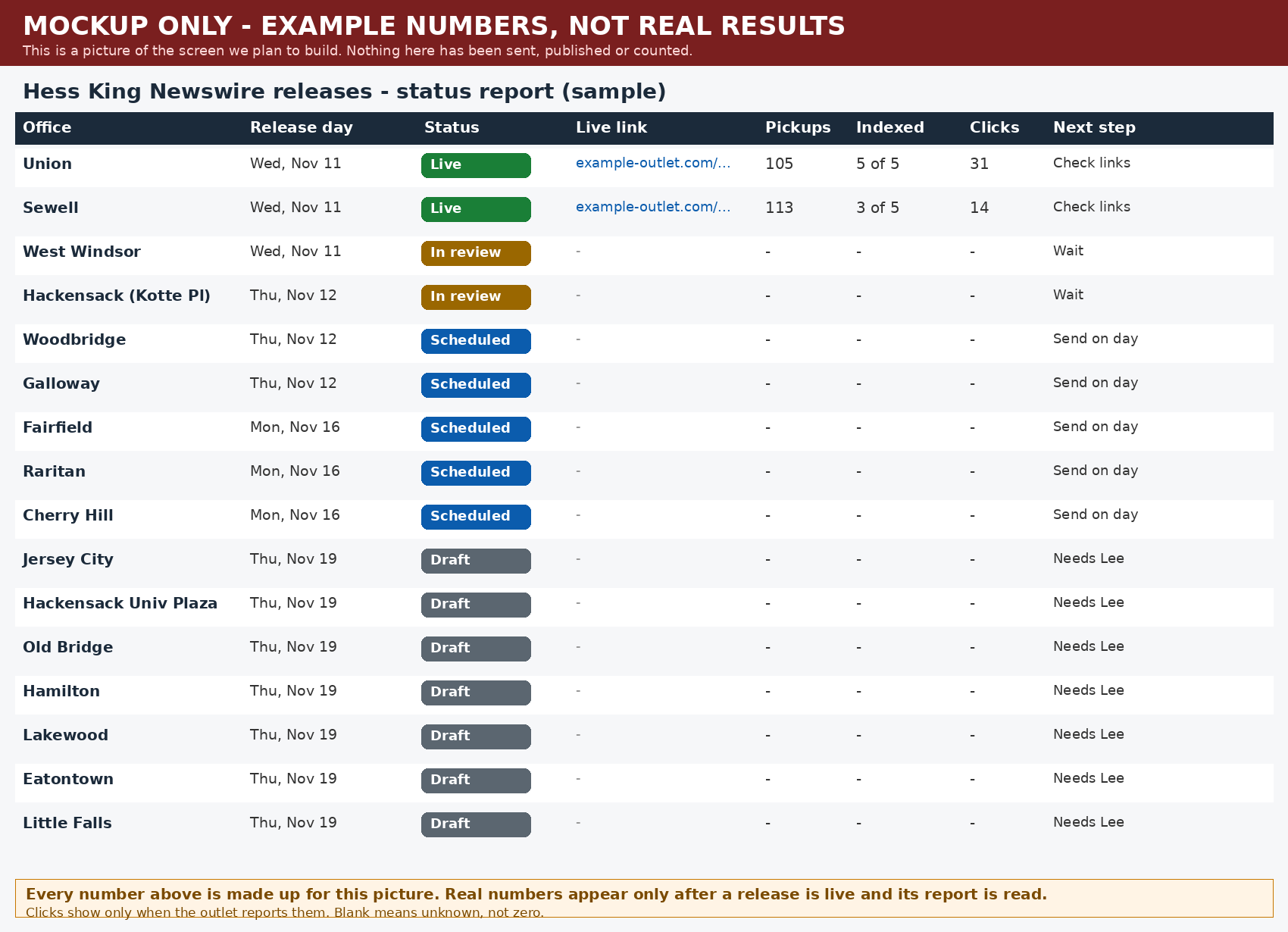
Mockup of the reporting screen. Example numbers only, not real results.